Sunday, 10 November 2013

Paul Klee: Making Visible. Tate Modern 2013-2014


Paul Klee at Tate Modern: Making Visible 2013/2014


Paul Klee 1921
No other artist of the twentieth century made marks, lines and doodles sing with quite the same melody as Paul Klee. As a result, you’ll spend ages peering at and poring over the witty, joyful masterpieces in this career-spanning retrospective of the Swiss-German artist, watching Klee’s ideas spring to life on canvas and on tiny sheets of paper that become flickering constellations. It's hard to imagine now that his intricate, fantastical art was regarded as 'degenerate' by the Nazis in the early1930s. At that time, Klee was teaching at the Düsseldorf Academy. When he returned to his native Bern in Switzerland in 1933, his work became darker in tone, reflecting the deteriorating political situation and his severe illness – diagnosed as scleroderma in 1936.
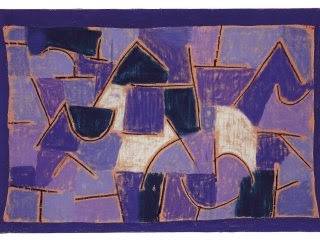
Blue Night 1937

The Tate's exhibition challenges Klee’s reputation as a whimsical dreamer – famous for describing drawing as being like 'taking a line for a walk – drawing attention to the rigour with which he recorded and catalogued his work throughout his career. We can’t time-travel to enter Klee’s studio and see how his works progressed but, in offering up paintings made in sequence, Tate Modern’s show gives us the next best thing. Moving through the exhibition is like seeing a series of snapshots of Klee’s working life. You’ll discover how paintings developed in tandem or relay, like the Tate’s famous watercolour ‘They’re Biting’, which is flanked by three works that precede it and one that follows. Or how they may have been revisited and reworked over time, like ‘Akt (Nude)’, which Klee started in 1910 but didn’t finish until 1924.
Tate’s reappraisal sheds light on dualities in Klee’s character. He was a talented musician (he played the violin, often to make ends meet) as well as an artist. He was also ambidextrous, painting and drawing with one hand while writing with the other. This stunning show also reveals that, while there are elements of cubism, surrealism and pointillism in his work, he was, above all, an individualist. It leaves you with a sense of creative, personal enquiry about the world that is uplifting and truly inspiring.

 Static Dynamic Intensification

Paul Klee at Tate Modern: curator interview(Matthew Gale)


Paul Klee is forever associated with his famously quirky description of drawing as ‘taking a line for a walk’. The stories about the Swiss-German artist that have stuck since his death in 1940 are similar eccentric. There’s the tale of his first day of teaching at the Bauhaus in 1921, when Klee, then aged 41 and already well-known in Europe, is said to have backed through the door of the classroom, avoiding eye contact with his students, drawn two arcs on the blackboard and declared: ‘This is the fish of Columbus!'


Another anecdote from around 1930 – by the American art collector Edward MM Warburg – places Klee in his Dessau studio. When the artist’s beloved cat Bimbo ambles across the still-wet watercolours they are admiring, Warburg tries to shoo it away. Klee, however, just laughs and says: ‘Many years from now, one of your art connoisseurs will wonder how in the world I ever got that effect.’
Steps 1929


These accounts are of a piece with Klee’s endlessly innovative and apparently effortless paintings and works on paper, with their flowing lines, glowing patchworks of colour and whimsical depictions of animal, plant and sea life.


‘Klee’s work is always about what it means to be in the world, how to process it,’ says Matthew Gale, curator of the first Klee exhibition in London for more than a decade. Yet, behind the freewheeling genius there was another, altogether more obsessive side to this modern master. Throughout his career, Klee used a variety of numbering systems – made up of the year, month and day – as a way of documenting his prodigious output. His apparently spontaneous creativity, which led to a total of 9,000 works being produced during his lifetime, was always held in check by this analytical approach to numbering his work. It was his way of revisiting what he had made, making sense of quickfire artistic impulse.


Featuring around 200 paintings, Tate Modern’s new show foregrounds this characteristic, using it to delve deep into Klee’s creative processes. ‘The way in which the exhibition is structured derives from Klee’s own numbering system, which he started in 1911,’ explains Gale. ‘The purpose is to show the incredible diversity of his production.’


Comedy 1921


Museum exhibitions are great at presenting us with end results – those polished, cherished icons of art history. They’re often less adept at revealing how those results came into being. We can’t time-travel to enter Klee’s studio and see how his works progressed but – in offering up paintings made in sequence – Tate Modern’s show gives us the next best thing. Moving through the exhibition is like seeing a series of snapshots of Klee’s working life. You’ll discover how paintings developed in tandem or relay, like the Tate’s famous watercolour ‘They’re Biting’ (1920), which is flanked by works that precede and follow it.


Tate’s reappraisal sheds light on dualities in Klee’s character. He was a talented musician (he played the violin, often to make ends meet) as well as an artist. He was ambidextrous, painting and drawing with his left hand while writing (and signing the work) with his right. ‘I think cataloguing the work allows him to have a structure,’ explains Gale. ‘This clear, orderly side to him means he can open the door of his studio and range freely as his imagination allows him.’


If Klee is underappreciated in Britain, Gale puts it in part down to fashion: ‘We’ve passed through a sort of dip in his reputation and I hope that we’re going to inspire a new generation to look at Klee in a different way.’ It may also be due to the juggernaut of art history. While Picasso will forever be linked with cubism, Matisse fauvism and Seurat pointillism, Klee’s fame may have suffered from a lack of ties to any particular art movement. ‘“Isms” aren’t everything,’ says Gale. ‘I think the fact that Klee isn’t associated with an “ism” can make him difficult to categorise, but I think that is probably also the strong point in his legacy – that he provides an example of an incredibly rich creativity that’s not pigeonholed.
 Full Moon 1933


Klee was certainly celebrated in his lifetime, with a solo exhibition at the Nationalgalerie in Berlin in 1921 and a retrospective at the Museum of Modern Art, New York, in 1930. During the final decade of his life, Picasso and Wassily Kandinsky came to pay tribute to the master in Bern, Switzerland, where Klee took refuge after his work was deemed ‘degenerate’ by the Nazis and he was dismissed from his teaching position in Düsseldorf.


By this time he had been diagnosed with scleroderma, a debilitating hardening of the skin. Klee’s numbering of his work didn’t stop but his production became erratic. In 1936,  he produced just 25 works, while in 1939 he made more than 1,000 paintings and drawings that ‘fell like leaves’ around him. The last work he numbered in 1940, a leap year, is 366. ‘There seems something very symbolic about stopping with that number as if he feels he’s completed that year’s work,’ says Gale. ‘He clearly knew he was dying.’


While this casts a shadow over Klee’s later works, many of his final paintings are defiantly upbeat, like the joyously rhythmic ‘Twilight Flowers’ (1940). It’s this sense of playful enquiry about the world which Gale hopes visitors will take away with them. ‘I think you’ll get a sense of the amazingly productive journey he goes on, and go away inspired to make work yourself, in whatever realm. Klee wrote, as well as playing the violin and painting, making his own brushes and puppets for his son. His is not an exclusive sort of creativity but one that encourages you to explore that creative part of your life.’ Who knows, maybe you’ll even get the cat to take a line for a walk too

Fourth Plinth 2014


Fourth Plinth Commission 2014


Exhibition of Proposals for the Fourth Plinth, Trafalgar Square, London, to be exhibited 2014


St Martin-in-the-Fields 25th September to 17th November 2013   


Marcus Coates has proposed to place a large replica of ‘The Eagle’, a rocky outcrop situated in Brimham Rocks, Yorkshire on the plinth; Trafalgar Square is almost entirely fashioned from stone, sourced from all over Britain and manipulated into buildings, pillars and statues by the will of architects, designers and sculptors. Marcus Coates plans to contrast these symbols of rational progress with a huge replica of a gritstone outcrop created hundreds of millions of years ago in Yorkshire by the natural forces of ice, wind and rain. Its form suggests a face or a bird, as we automatically try to make sense of the organic shapes that emerge and retreat as we walk around it, and invest it with human qualities or mythical powers. It would be a monument to non-human creativity and a totem of timeless, irrepressible powers.

Coates makes videos, performances and installations that are in turn sublime and humorous, asking audiences and participants to explore their imaginations in ways they might not ordinarily. Communing with animal and bird spirits, emulating their movements or transmitting their calls and cries, the artist attempts to answer questions on how we can live in urban societies. His observations might strike a chord with his audiences through metaphor, or through the sheer desire to make sense of a disordered universe.


David Shigley’s design, Really Good, is a 10-metre-high thumbs-up, cast in the same dark patina as the other statues in the square; A giant hand in a thumbs-up gesture, and with a really long thumb at that, must mean that something, somewhere, is really good. But what is that something and where is it? Is it Trafalgar Square? Or all of London? Or maybe the artwork itself? And if it’s so good, why is that? Who says so? And will we agree?

Really Good would be cast in bronze with the same dark patina as the other statues in the Square, the comic extension of the thumb bringing it up to ten metres in height. Shrigley’s ambition is that this will become a self-fulfilling prophecy; that things considered ‘bad’, such as the economy, the weather and society, will benefit from a change of consensus towards positivity.

Shrigley’s daily tirade of satirical vignettes takes the British tradition of satire into three and four dimensions. In his drawings and animations protagonists express their dark impulses and are subject to the violence and irrationality of life, while his sculptures are often jokes in 3D form, reflecting the absurdity of contemporary society.


Hans Haacke has created a skeletal, riderless horse that will display the live ticker of the London Stock Exchange on an electric ribbon tied to its leg; Instead of the statue of William III astride a horse, as originally planned for the empty plinth, Hans Haacke proposes a skeleton of a riderless, strutting horse. Tied to the horse’s front leg is an electronic ribbon which displays live the ticker of the London Stock Exchange. The horse is derived from an etching by George Stubbs, whose studies of equine anatomy were published the year after the birth of the reputedly decadent king, whose statue was abandoned due to a lack of funds. Haacke’s proposal makes visible a number of ordinarily hidden substructures, tied up with a bow as if a gift to all.

Haacke’s early work employed physical and organic processes, such as condensation, in what he called ‘systems’, until his focus shifted to the socio-political field of equally interdependent dynamics. For the last four decades Haacke has been examining relationships between art, power and money, and has addressed issues of free expression and civic responsibilities in democratic societies. Haacke’s practice is difficult to categorise, moving from object to image to text, from painting to photography, at times of a provocative nature.


Liliane Lijn’s proposal shows two identical kinetic cones made of brushed anodised aluminium engaged in a mesmerising dance; Rather than one imposing sculptural object, Liliane Lijn’s proposal The Dance features the complex changing relation between two apparently identical objects. The cone is a ubiquitous abstract form that occurs in mathematical, mythical and astronomical systems. Here the cones also relate to the spire of St. Martin-in-the-Fields, while their gleaming metallic surfaces recall the machinery of space travel.  Once The Dance begins, formal geometry gives way to sensual movement and we become mesmerised by the energy of the interaction.

The shifting shapes and interactions of The Dance are an extension of Lijn’s interest in combining energy and matter, language and light. Her small and large-scale kinetic installations often use technologies such as laser cutting, programmable electronics and aerogel, a material used by NASA to capture stardust. Lijn’s Poemcons and Poem Machines, rotating cones and drums bearing evocative words and phrases, offer tantalising fragments of meaning and insight, while ultimately falling apart in the mind.


Ugo Rondinone’s Moon Mask is an aluminium, abstract sentinel facing out over the square; Ugo Rondinone’s MOON MASK, modelled expressively by hand, enlarged, cast in aluminium, and fixed to a pole, would be an abstract sentinel facing out over the square. MOON MASK seemingly refers to many visual traditions – perhaps the folk art of an ancient clan or early 20th century Cubism, which was itself influenced by African tribal masks – and yet it makes no specific claims for its origin. The eventual work would inspire free association, its three window-like apertures suggesting portals through which cultural references and individual emotions can tumble at will.

Rondinone’s preoccupation with time - at the cosmic scale as well as that of art history and everyday experience - often finds form in abstract imagery intended to connect the sublime with the everyday. His optically shimmering mandala paintings, for example, re-use the geometric Buddhist symbol for eternity. Elsewhere figures made from stacked, roughly hewn cubes of rock seem to express an ancient sense of awe in the face of nature, while also offering a range of contemporary readings from the psychological to the comical.


Mark Leckey has designed a creature made of amalgamated elements of the permanent statues in Trafalgar Square, including details from the statues of James II, Admiral Jellicoe, the water fountain, and the Fourth Plinth itself.  Mark Leckey has riffed on elements traditionally found carved in marble or cast in bronze, including scrolls, coats of arms and a sword in its scabbard for Larger Squat Afar (an anagram of Trafalgar Square). 
“I believe the proposal reflects how we now approach the world in the 21st century. Because of current technology, objects and artefacts are no longer these fixed, permanent things. Instead we look at any sculpture, object or image and ask, what can I do with that? How can I change it to suit my desires?”

Larger Squat Afar is an anagram of ‘Trafalgar Square’, and Mark Leckey’s chimera is itself an amalgam of elements lifted from all the statues found in the square. Details of James II, the water fountain, Admiral Jellicoe and the plinth itself are enmeshed into a single figure, which, while appearing absurd illustrates the compound history of both people and place. Fabricated using 3D laser scanning and printing technology, Larger Squat Afar embodies the power of the digital to overcome the physical and to fulfill the more monstrous capacities of the human imagination.

Leckey frequently looks to the mediated nature of public and private environments, in which imagery is employed to transcend the mundane. Collage and animation techniques are used in videos and sculptures, where the hidden is made explicit, desires are expressed and obscure personal narratives are revealed. It is digital platforms, above all else, that signal the contemporary for Leckey, where even the inanimate object can appear to communicate to us at will.


ARTIST BIOGRAPHIES


Marcus Coates

Born 1968 in London. Lives and works in London.

Marcus Coates makes videos, performances and installations that attempt to answer questions about how we live in urban societies. He has had recent solo exhibitions at South Alberta Gallery, Canada (2012); and Milton Keynes Gallery (2010). Recent public art projects include Create London (2013) and Vision Quest: a ritual for Elephant & Castle (2012). Coates has also performed at Port Eliot Festival, Cornwall; Mori Art Museum, Tokyo; Kunsthalle Zurich; Barbican Art Gallery, London; and Hayward Gallery, London.


Hans Haacke

Born 1936 in Cologne. Lives and works in New York.

For the last four decades Hans Haacke has been examining the relationships between art, power and money, and has addressed issues of free expression and civic responsibilities in democratic societies in his work. He works in many different mediums including painting, photography and written text. He has had recent solo exhibitions at Museo Nacional Centro de Arte Reina Sofía, Madrid (2012); MIT List Visual Arts Centre, Cambridge, MA (2011); X-Initiative, New York (2009); and Akademie der Künste, Berlin (2006). Haacke’s work has been included in four Documentas and numerous biennials around the world. He shared a Golden Lion Award with Nam June Paik for the best pavilion at the 45th Venice Biennale (1993), and in 2000 he unveiled a permanent installation in the Reichstag, Berlin.


Mark Leckey

Born 1964 in Birkenhead. Lives and works in London.

Mark Leckey’s work explores the mediated nature of public and private environments, often working collage and animation techniques into his video and sculptural work. He has had recent solo exhibitions at The Hammer museum, Los Angeles (2013); Banff Centre, Alberta (2012); Serpentine Gallery, London (2011); Abrons Art Centre, New York (2009); and Kölnischer Kunstverein, Cologne (2008). Leckey curated the Hayward Touring show ‘The universal addressability of dumb things’ (2013) and was awarded the Turner Prize in 2008.


Liliane Lijn

Born 1939 in New York. Lives and works in London.

Internationally exhibited since the 1960s, with works in numerous collections including Tate, the British Museum, and the V&A, and FNAC, Paris, Lijn is best known for her kinetic sculptures and her work with language and light. Recent exhibitions include Light Years at Sir John Soane’s Museum, London (2011); Gallery One, New Visions Centre, Signals, Indica at Tate Britain, London (2012); Ecstatic Alphabets/Heaps of Language at MoMA, New York (2012); and Cosmic Dramas, mima, Middlesborough. Recent public commissions include Solar Beacon, a sci-art installation of heliostats on the towers of the Golden Gate Bridge; and Light Pyramid, a beacon for the Queen’s Jubilee, which was commissioned by Park Trust and MK Gallery, Milton Keynes.


David Shrigley

Born 1968 in Macclesfield. Lives and works in Glasgow.

David Shrigley’s work draws on the British tradition of satire, creating drawings, animations and sculptures that reflect the absurdity of contemporary society. He has had recent solo exhibitions at Bradford 1 Gallery (2013); Cornerhouse Gallery (2012), Hayward Gallery, London (2012); Yerba Beuna Centre for the Arts, San Francisco (2012); and Kelvingrove Museum, Glasgow (2010). Shrigley’s Sort of Opera: Pass the Spoon was performed at Tramway, Glasgow, and Southbank Centre, London (2011 – 12), and he has been nominated for the Turner Prize 2013. 


Ugo Rondinone 

Born 1964 in Brunnen, Switzerland. Lives and works in New York.

Ugo Rondinone is a mixed-media artist whose work explores themes of fantasy and desire. He has had recent solo exhibitions at M Museum, Leuven (2013); Art Institute of Chicago (2013); Common Guild, Glasgow (2012); Museum of Cycladic Art, Athens (2012); and Aargauer Kunsthaus, Aarau (2010). Rondinone has created public commissions for the Rockefeller Plaza, New York; the IMB Building, New York; and Louis Vuitton, Munich. He represented Switzerland in the 52nd Venice Biennale (2007).


Friday, 8 November 2013

Angel sculpture 2013

Angel by Kathryn Moores 2013. Glass, copper, brass, aluminium, plastic, paint and chicken bones.

An assemblage of discreet pieces creating an entity reminiscent of a biology specimen from a Victorian collection.  The anatomical influences make it at once recognisable as a rib cage, but the additional features, such as the moulded glass candlestick which acts as a stand, represent a clashing of eras and therefore timelessness.
The robot-like structure, referencing the early 1980's mechanical sculptures by the likes of Oppenheim, attempts to suggest a clashing as well as harmonious composition.
The chicken rib 'heart' invites the viewer to step forward and engage with the piece and is the only organic piece in a work which suggests the human form, if somewhat distorted.
The metal sternum invokes craftsmanship whilst the plastic foam ribs show modernity and disposability.

Inside the rib cage, suspended on brass plated wire is the red painted rib cage of a chicken in place of the heart.

Moulded glass candlestick base on magnifying mirror. 


Wednesday, 6 November 2013

Is All Art Religious?

God is Dead
Signs in Peckham
Christopher Clack
2011
 
Art as a Facilitator of Society. 

Is all Art Religious?  Is all Religion Art?

These two over-simplified questions are not reversals of one another.
 In the first question the term Art refers to not just those creative expressions of a society in which all basic needs are met and there is time for recreation and self-expression, but to the practices which have been associated by a structured society to basic needs as well, such as the astrological agricultural practices of the Ancient Egyptians.  This requires a suitably developed social structure which has had time to contemplate non-material explanations for material or natural phenomena.  Art in the first question might also encompass methods which today are regarded as occupying a field completely separate to Art, for example mathematical models of the universe or alpha-numerical sequences of purported significance, the most common, useful and contemporaneous of these, I propose to be the study of Fractals, mathematical sets whereby patterns are the same at every scale or nearly the same at different scales, vaguely comparable to infinite regression.

To be Religious, as the first question is phrased, does not require that something is part of a formal structure or a recognised Religion.  The term encompasses a variety of spiritual, ritualistic and pseudo-scientific phenomena which have parallels across many societies, such as astronomy, idol worship and deification.  Symbolism is a common theme in Art and Religion.

In the second question, Art is a similar concept, but whereas some Art is obviously apparent as itself, the paintings and mosaics of churches around the globe for example, the term encompasses the written and spoken word, the staging of events as managed theatrics, music and decorative visual arts.  In this second question Religion does refer to formal structured religions. 
It requires that all human beings have similar cognitive processes and respond in predictable ways.  Neurotheology (a term from Huxley’s novel Island) is the study of the brain and Religion, and the search for the God Spot.  Responses to Religious stimuli are monitored, but as the extent of any spiritual experience is entirely subjective and so the studies are no more in depth than showing correlations.  There has been research into an evolutionary history for religion.  Nicolas Wade, a British science writer for the New York Times wrote, 

“Like most behaviours that are found in societies throughout the world, religion must have been present in the ancestral human population before the dispersal from Africa 50,000 years ago. Although religious rituals usually involve dance and music, they are also very verbal, since the sacred truths have to be stated. If so, religion, at least in its modern form, cannot pre-date the emergence of language. It has been argued earlier that language attained its modern state shortly before the exodus from Africa. If religion had to await the evolution of modern, articulate language, then it too would have emerged shortly before 50,000 years ago.” (N. Wade. Before the Dawn. Penguin Books 2006 .p.8 p.165)

It may be that religion conferred an evolutionary advantage on those who followed it and it may therefore have been naturally selected for.  Advantages of religion may include social cohesion and thus the elaborate and expensive (in terms of time, money, danger etc.) individual religious practices and ceremonies show the extent of an individual’s commitment to a group (Sosis, R.; Kress, H. C.; Boster, J. S. (2007). "Scars for war: evaluating alternative signalling explanations for cross-cultural variance in ritual costs". Evolution and Human Behavior 28 (4): 234–247).

It is impossible to argue that Art is cheap.  One need only to wander into a moderate village Church in the U.K. and if it was constructed before The Reformation (the actions of Martin Luther in 1517 are seen as the starting point in this) then it will have been constructed from and decorated with expensive and elaborate materials.  There are famous examples around the globe of elaborate sacred sites.

There is, once we acknowledge the historical significance of Religion even if it is not as evident today, a lot of power tied up with, not only the physical wealth of, but also the administration of Religion.  In England the Bible was not published in the language of the population until, at the earliest, the tenth century, but it was not translated into Modern English until the early sixteenth century when John Tyndale produced his widely distributed version.  This was also the first press-printed Bible. Thus the work of translating the most important theological ideas to the masses was in the power of an Elite.  The use of visual representations of interpreted scriptural messages was commonplace and thus Art was the language of Religion.  It is easy to believe that those holding such sway over the masses would not wish to relinquish it but to reinforce it through elaborate and mysterious ceremonies and so an understanding of stage craft would be beneficial.

Today, in the UK, we inhabit an increasingly Secular society and yet our brains are no different from those of our forebears.  Religion may be distant from our lives but Art is almost inseparable from it.  Unless we live in the most remote Crofting community, I would suggest that daily life is awash with music, design, architecture, photography and film.  It may be that sculpture and mass produced pictorial Art is not everywhere but it is not hard to find and fine examples of original works, such as paintings and sculpture have to be sought out by an individual but there is designated government funding to make these works available to the public.

If Art is not required as a religious tool anymore and, in general, the population is turning away from Religion, then why should Art retain any importance to us?  Is it a way to access the same basic emotions associated with the human condition and the universal practical issues of living in a society?  As we academically turn towards scientific explanations for material phenomena, we cannot accept the teachings of Formal Religion, but we retain a need for what it provided us with.

  Art was a facilitator for this in the past exactly as it is now.